

The launch of the election campaign does not suspend government relations activities with the Québec government or the application of the Lobbying Transparency and Ethics Act, which governs influence communications with public office holders. Many activities may therefore continue, but the applicable rules vary depending on the person being approached, the purpose of the activity, and the type of communication contemplated.
The dissolution of the National Assembly changes the status of certain public office holders. At the same time, the Election Act establishes a separate framework for third-party activities and spending, particularly with respect to public communications, partisan advertising, and events. Organizations must therefore understand these changes to limit compliance risks.
Who remains a public office holder after the dissolution of the National Assembly?
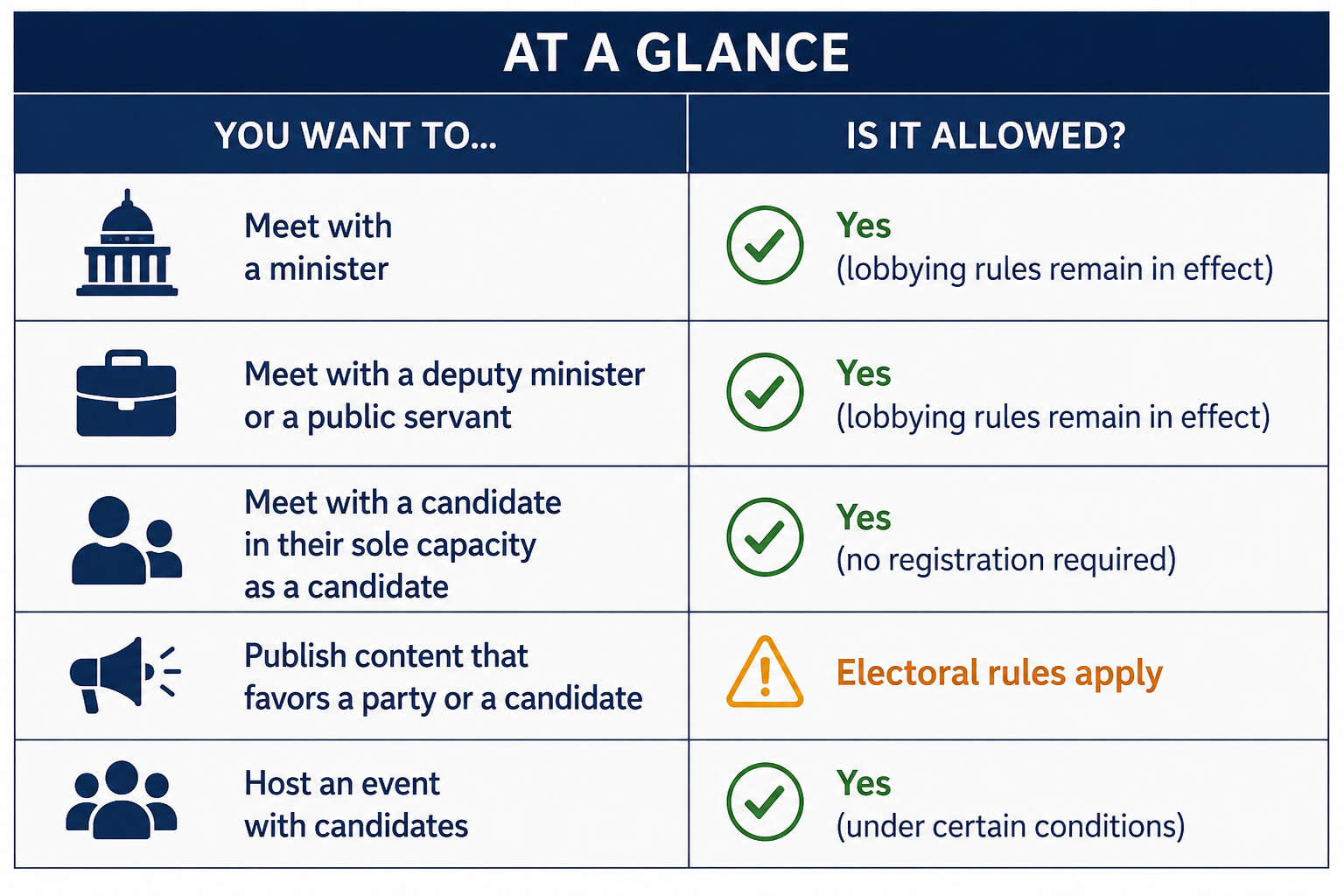
- Outgoing MNAs and candidates: MNAs cease to be public office holders as soon as the National Assembly is dissolved. An outgoing MNA who was neither a minister nor the President or a Vice-President of the National Assembly is therefore no longer a public office holder. A communication with that person solely in their capacity as a candidate does not need to be registered in Carrefour Lobby Québec.
- Ministers: A minister remains in office until a successor is appointed, whether or not the minister is re-elected. Influence communications with a minister who is also a candidate therefore remain subject to the rules when they concern a government decision. Ministers remain public office holders.
- Presidency of the National Assembly: The President and Vice-Presidents remain in office until they are replaced or re-elected. They remain public office holders.
- Public administration: Deputy ministers, political staff who remain in their positions, public servants, and employees of government bodies continue to perform their duties during the election campaign. Influence communications directed at them therefore remain subject to lobbying rules.
Lobbying rules that remain in effect
- Nature of the activity: It is not the meeting itself, but its purpose that determines whether the Act applies. An oral or written communication intended to influence a legislative, regulatory, or administrative decision constitutes a lobbying activity; a simple request for information does not. Arranging, on behalf of a third party, a meeting with a public office holder is also considered a lobbying activity when the meeting is intended to influence a decision covered by the Act.
- Carrefour Lobby Québec: The registered mandate must describe, among other things, the decision being sought, the institution concerned, the positions held by the people being approached, the period covered, and the means of communication used. Registration deadlines remain unchanged: 30 days for a consultant lobbyist (or for any amendment to a mandate) and 60 days for an enterprise or organization lobbyist.
- Conduct: Lobbyists must clearly identify themselves and specify the organization or client they represent, as well as the purpose of their activities. They must also provide accurate and up-to-date information, avoid misleading representations or undue pressure, and comply with confidentiality obligations.
Before and during the campaign: What changes
- Pre-election period - from January 1 to the date of the election order: The usual lobbying rules continue to apply. Since 2026, an organization planning to run pre-election partisan advertising with a total value of more than $1,000 must register with Élections Québec, identify itself in the advertising, and file a report after the election. This requirement applies to advertising that clearly refers to a party, a candidate, or a specific element of a party’s platform.
- Election period - from the day after the election order until election day: The rules become more restrictive. An organization generally cannot incur expenses intended to promote or oppose a party or candidate, even indirectly. The rules also cover activities related to the platforms, commitments, or policies advocated by political parties. Any such expense must be authorized and incurred by the official agent of the party or candidate. Design, production, and distribution costs, and, in some cases, staff costs associated with content published on social media, are also taken into account.
- Assemblies and meetings: An organization may continue to hold events as part of its normal activities, provided they remain non-partisan and relate to its mission. When an event concerns a particular electoral division, all candidates must be invited on an equitable basis. Certain meetings may also qualify for an exception when their total cost does not exceed $200 during the campaign.
- Platform comparisons: These remain permitted if they are produced as part of the organization’s usual activities, address issues related to its mission, and present all authorized parties or all candidates in the same electoral division equitably. They must be neutral and distributed through the organization’s usual channels, without photos, videos, comments, analyses, assessments, or other elements that could promote a candidate or party.
Be mindful of communications surrounding meetings: A meeting that complies with lobbying rules may nevertheless raise issues under the Election Act. A photo, video, news release, or sponsored post that gives visibility to a candidate may be subject to election spending rules. Any public communication involving costs should therefore be reviewed before publication.
Our recommendations
- Before any meeting, confirm the status of the person you are meeting, the context of the meeting, and the decision or commitment being sought.
- When meeting with a minister, political staff member, or public servant, make sure the mandate registered in Carrefour Lobby Québec covers the institution, the position of the person being met, and the purpose of the activity. We also recommend keeping a record of the communications.
- When meeting solely with a candidate, no registration in the lobbyists registry is required. However, any public activity or communication associated with the meeting should be assessed against the requirements of the Election Act.
NATIONAL’s government relations teams can support you at every stage: assessing how lobbying rules apply, confirming obligations under the Election Act, preparing for meetings, reviewing registrations in Carrefour Lobby Québec, and, where necessary, obtaining clarification from Lobbyisme Québec or Élections Québec.
 Watch the interview here. Available only in French.
